


Just got back from Nebraska a week before that. Had a precious two weeks at home between North Carolina and Nebraska. Took a train to New York City on Monday, so I can read at Bryant Park on Tuesday evening.
I'm a little surprised I never titled a blog post "Home Again, Home Again" until now. I did title one "Jiggedy-Jig" on October 1, 2006. That was a short, Millay-Colony-aftermath update that included a prescient announcement: New manuscript title: "Theories of Falling"...
As I type that, I feel both the nostalgic wave of joy that I got my first collection published at all, and then one of sadness that New Issues Poetry & Prose—which gave a start to so many poets, including Jericho Brown and Chet'la Sebree—was recently shuttered by the university that should have protected it. I have to link to the University of Chicago Press's distribution page here, because that's the last place one can easily survey the incredible back catalogue. You should grab copies while you can! The future of that distribution relationship is TBD once October 2023 is behind us. The New Issues website is down, perhaps for good, since there’s no longer staff to follow up on getting the URL registration renewed. Ooof. This is such a harrowing time for university presses and MFA programs on an infrastructure level, which is in such sharp contrast the vitality of these programs in person.
People still sometimes find “Chicks Dig Poetry” through a particular archived post, or because someone mentions it while using an old bio note to introduce me at an event. I don't plan on ever retiring the blog entirely unless (until) technology forces my hand, even if it survives simply as one or two posts a year. Everyone should have a place to speak freely on the internet, and recent months have made it clear that Facebook, Twitter/X, and other social media platforms are only “free” up until it is the whim of their owners to dictate otherwise. That surely applies to this place too—I notice that one of my posts has been flagged for “sensitive” content, though I can’t tell which one. But for now, I’ll treat it as the closest I have to a soapbox in the public square. (For timely updates, you can always check www.SandraBeasley.com.)
On a practical level, here’s what has happened since I last checked in: I started three jobs in the space of six months. I don't recommend that pacing for the sake of work-life balance, but it was worth it. I’m putting in more hours with Maestro Group, finding that I enjoy consulting on messaging and other projects beyond writing blog posts on inter-office communication styles.
I also began a faculty affiliation with the University of Nebraska Omaha’s low-residency MFA program, which takes me to the Lied Lodge in Nebraska City twice a year. (Although not as glamorous a setting as the University of Tampa, where I taught until the program’s closure in 2020, this MFA program doesn’t run the risk of losing students to the temptations of Ybor City.) In July, I watched my first thesis student give his graduating presentations.


My husband restarted his artistic practice thanks to an affiliation with the McColl Center, and I sometimes joined him for Tuesday evening figure drawing sessions led by artist Felicia van Bork, who happens to also be married to AMP. Old friends from grad school and even high school days (!), plus new friends in the form of my English Department colleagues, helped us feel welcome.
Davidson is deeply invested in learning, and the administration understands that learning cannot flourish in an atmosphere of scarcity. There was just so much about the school that miraculously functioned the way it was supposed to (anyone who has spent time in academia will understand my sense of wonder). Conversations were lively. Classrooms were bright and airy. Tech worked. Accessibility needs were met. The copy machine had paper in it. The campus was teeming with artworks, and hosted a robust guest speakers that included Natasha Trethewey, Robin Wall Kimmerer, and Rhiannon Giddens. My 26 students were amazing, the kind of curious and creative minds that any professor dreams of having in the classroom. I’m pretty sure I coaxed a few to fall in love with sestinas and golden shovels, braids and abecedarians; more importantly, I hope I helped them connect with their voices on the page.

The nature of the McGee gig is that it is one-and-done, but we fell a little in love with North Carolina life. I’m going back for a Charlotte Lit reading on December 1. Maybe I can eventually get someone to take me out on Lake Norman.
In early spring, American University queried about my return for the 2023-2024 school year. The administration cautioned that while they wanted to count on me to teach, locking in my schedule and advertising classes under my name, I wouldn’t actually receive my nine-month contract offer until late summer—and as always, it would be budget permitting. This is the operating norm of so many colleges and universities these days: a perpetual limbo of contracts that are nonrenewable and provisional, on paper, but in practice are essential to the integrity of a department.
I love AU’s community, and I’m appreciative of all who advocated for me to be in the position of being asked to return. In particular, I believe it is so important to carry on Richard McCann’s legacy of workshopping creative nonfiction, and I was excited to teach a new class I’d developed on the ethics of writing creatively. But that "budget permitting" wilted my spirit. I couldn’t figure out a sustainable way to stay. The salary offered for a 3:3 wasn’t enough to for us to afford our place in DC, with me acting as a sole income provider managing medical debt, and yet the job would be too time-consuming to coexist alongside other work. Plus, I’d have to look forward, come summer 2024, to figuring out my options all over again.
So I decided it was time to move on. In a sense, “moving on” is exactly what will permit me to stay around and continue taking part in AU events (including sitting on another half-dozen MFA thesis committees). I'm not really going anywhere! I just want to feel like an enthused alumna who occasionally visits Writers in Print and Person, not a burned-out contract worker wondering how to convince others to assign quantifiable value to her service.
Shortly after making that decision, I sent out a burst of applications to residencies, and one yielded a yes—I’ll be at the Kimmel Harding Nelson Center for the Arts for one month beginning in mid-September—an opportunity that I could not have taken if committed being on a DC campus three days a week. (Thankfully, both my work with Maestro Group and the UNO MFA is portable.) Walking away from an opportunity to keep teaching at the institution that trained me as a writer feels wild and, frankly, inspires periodic pangs of regret. But I’m going to resist that conditioned, ever-looming sense of worry and take a chance on myself.
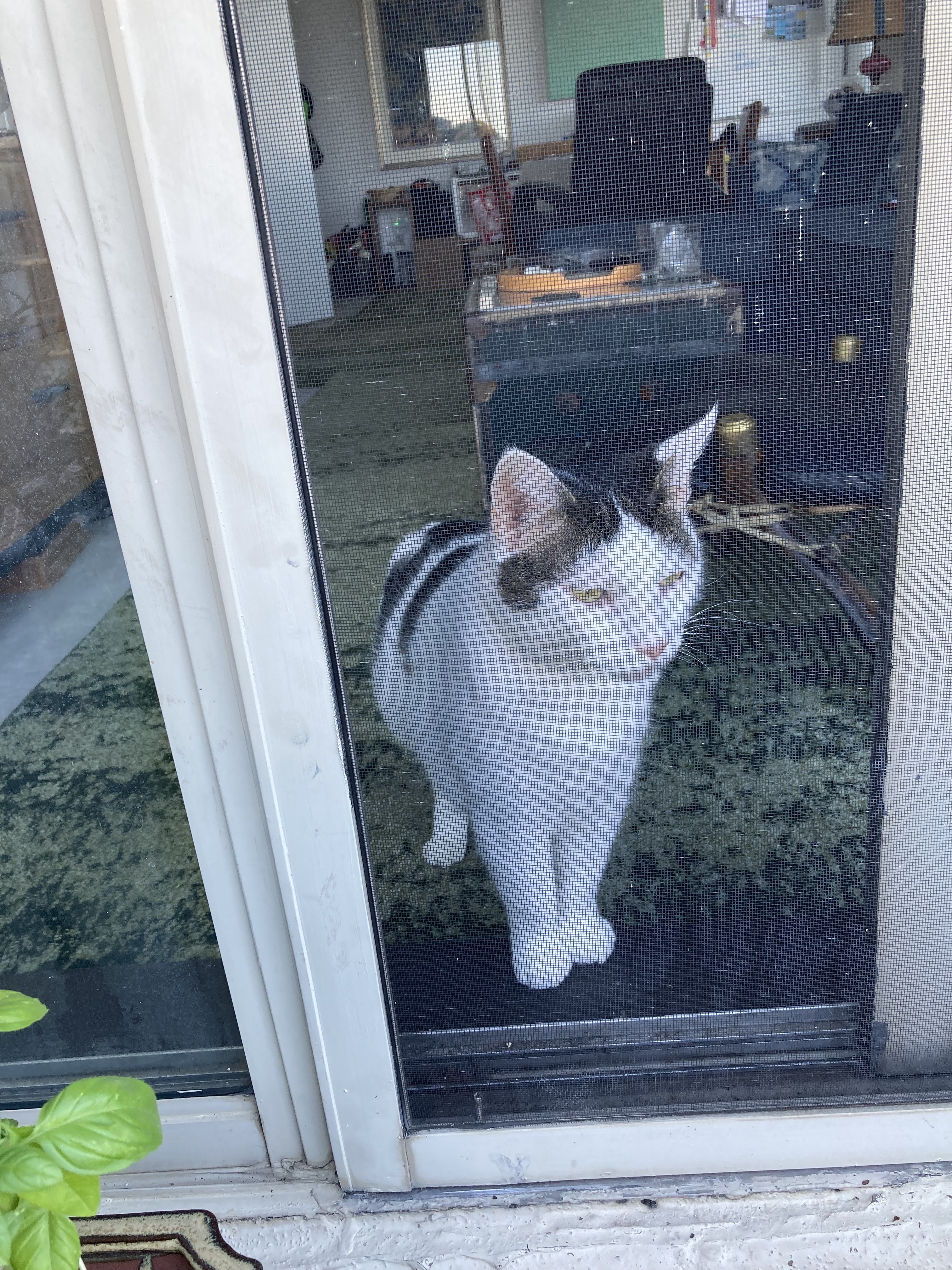
I'll probably have some other news to report before end-of-year. But even if I don’t, I’m grateful to be figuring it out little by little, with my husband in our apartment by the Southwest duckpond. I can't wait to wrap up my summer by looking out from our balcony filled with plants. Sal, of course, continues to serve in a supervisory position.


We're really lucky that my position at Davidson College offered a chance to get some perspective (and, to be honest, stabilize our finances). And I’m extremely grateful that Maestro and UNO, in a very short period of time, have provided so much foundational trust and camaraderie for me to build on when envisioning the commitments of future years. Our family and friends have lifted us up over and over, in the past year. A lot has happened. There's also a lot to look forward to.
Here's the thing: the universe can only give you new opportunities if you free up space in your life to hold them.


